The University of Nebraska–Lincoln (UNL) is a comprehensive research land-grant university with enrollment of 24,431 students (fall 2021). Founded in 1869, it serves as the flagship institution for the University of Nebraska’s five campuses and is part of the state’s broader higher education system that includes six community colleges and three state colleges.
The UNL Institute of Agriculture and Natural Resources (IANR) was created by the Nebraska Legislature in 1973 to ensure that agriculture would be appropriately resourced within UNL, given the supreme importance of agriculture and natural resources to the state’s economy and success. IANR is composed of the College of Agricultural Sciences and Natural Resources (CASNR), the Agricultural Research Division (ARD), Nebraska Extension and the ARD and Extension components of three departments in the College of Education and Human Sciences (CEHS). ARD is the only public entity in Nebraska charged with conducting agricultural research vital to Nebraska. And Nebraska Extension boasts the nation’s highest per capita involvement in 4-H with approximately 144,000 Nebraska youth representing one in three age eligible youth enrolled in Nebraska Extension’s 4-H program.
The School of Veterinary Medicine and Biomedical Sciences (SVMBS) is an academic unit within IANR and CASNR. SVMBS was formerly the Department of Veterinary Science until 2006, when the department was recognized as a school after the Professional Program for Veterinary Medicine (PPVM) was established with Iowa State University College of Veterinary Medicine (ISUCVM). SVMBS faculty and staff strive to ensure all programs and processes align within the framework of UNL’s N2025 Strategic Plan “where every person and every interaction matters.”
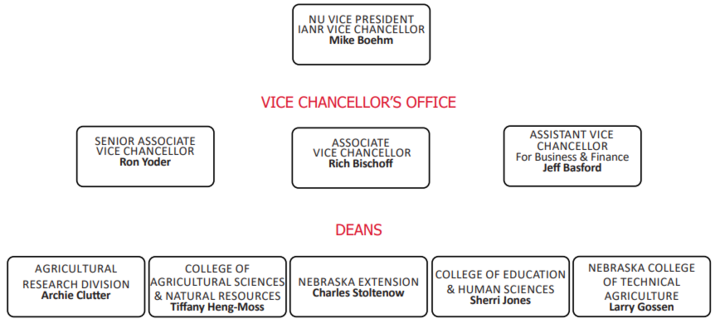
Institute of Agriculture and Natural Resources
University of Nebraska
Organizational Chart
Self-Study Scope and Organization
The first section of this document is a preliminary overview of the School of Veterinary Medicine and Biomedical Sciences (SVMBS) with a section describing critical and strategic questions. A section with a more detailed discussion of SVMBS mission areas follows. These descriptions are focused on the activities of the units and programs of SVMBS with discussion of missions and associated challenges and opportunities. The last section of the self-study contains a brief conclusion statement and a list of key strategic topics with questions intended to focus reporting and subsequent strategic planning and action.
SVMBS Overview
The School of Veterinary Medicine and Biomedical Sciences is Nebraska’s principle institution for education, research, and outreach related to veterinary medicine as well as veterinary and biomedical sciences.
Mission
The School of Veterinary Medicine and Biomedical Sciences advances animal health and well-being and the One Health concept through discovery by innovative research; timely extension and outreach; accredited diagnostic services; high quality, affordable and accessible education to undergraduate, graduate, and professional students. SVMBS addresses the needs of Nebraskans, the region, the nation, and the world through all these services.
This mission has been accomplished and the following strengths have been observed through the history of the program:
- The undergraduate programs offer a strong basic education to pre-veterinary and animal science students, with several courses led by DVM instructors.
- SVMBS has always had a strong research program that has addressed a broad array of stakeholder needs and interests. Graduate students from the program have been very successful and have made important contributions to veterinary and biomedical sciences.
- The Nebraska Veterinary Diagnostic Center (NVDC) has provided excellent and efficient service for the state and veterinarians. The diagnostic services have been a scientific and technical anchor for the School and offer a great resource for future research and graduate/resident training.
- SVMBS collaboratively established the Professional Program for Veterinary Medicine (PPVM) in 2006 with the Iowa State University College of Veterinary Medicine (ISU-CVM). The DVM graduates of this program have become successful professionals across Nebraska, the region, and the United States.
Vision
SVMBS will be known for high quality, innovative research and service, and affordable and accessible student-focused education in veterinary medicine and biomedical sciences.
Administrative Structure
The SVMBS director reports to and is evaluated by the IANR senior associate vice chancellor, Ron Yoder, as well as a collaborative matrix including the deans of the Agricultural Research Division (ARD), the College of Agricultural Sciences and Natural Resources (CASNR), and Nebraska Extension. The School director is responsible for the programs and budgets allocated to SVMBS.
The NVDC and the Great Plains Veterinary Educational Center (GPVEC) are each managed by directors who report to the SVMBS director. (Currently, Dr. McVey is the acting director of GPVEC, and Dr. Brian Vander Ley is the associate director.)
SVMBS shares a business center with the Department of Animal Science. The AVE Business Center provides accounting and personnel services for both departments. The SVMBS director and the Animal Science department head jointly supervise the AVE Business Center manager.
Faculty
At the time of this report (July 2022), SVMBS has a total of 34 faculty members. There are 24 tenure track faculty members, with two members planning to retire in 2023. There are three associate professors of practice and three assistant professors of practice. All the professors of practice have a DVM degree. There are two lecturers within the faculty. Two of the tenure-track faculty have split appointments with other IANR units, and one faculty member is temporarily assigned to another administrative unit. The School is currently (summer 2022) recruiting a replacement lecturer (clinical instructor) and a new, additional assistant professor of practice (pathobiology). The duty assignments for both positions will be at GPVEC in Clay Center, Nebraska.
Faculty appointments, expressed as full-time equivalents (FTE), are divided between research, teaching, extension, and service. There are 32 faculty members who provide 12.33 FTE in research, 31 who provide 12.30 FTE in teaching, five who provide 1.60 FTE in extension, and 10 who provide 5.79 FTE in directed and/or scholarly service (clinical or diagnostic). Drs. McVey and Brodersen provide 1.0 FTE administrative service each, and Dr. Vander ley provides 0.1 FTE of administrative service.
There have been two recent retirements among tenure track faculty (2020-2021). We are currently planning to replace one lecturer position at GPVEC that was vacated in January 2022. A second position in pathobiology/diagnostics as well as clinical teaching (professor of practice) will be added at GPVEC by fall 2022. There is a need for at least two additional faculty members to enhance clinical teaching and diagnostic services at the NVDC and GPVEC. SVMBS is exploring filling these openings as non-tenure track positions (professors of practice), but it would be preferable to create tenure track positions for these faculty since professors of practice are 90% or more dedicated to teaching.
Faculty apportionments, biographies, peer faculty salary comparisons, SVMBS committee appointments, graduate faculty information, and adjunct/courtesy appointments are listed in detail in Appendices 1-5 (available upon request).
Program Structure
The School of Veterinary Medicine and Biomedical Sciences is organized into six functional areas that serve IANR’s multiple and integrated missions of teaching, research, clinical/diagnostic services, and extension:
- Undergraduate studies
- Research and graduate programs
- Professional Program in Veterinary Medicine
- Great Plains Veterinary Educational Center
- Nebraska Veterinary Diagnostic Center
- Integrated extension programs
SVMBS receives funding from three IANR divisions—College of Agricultural Sciences and Natural Resources (teaching budget), Agricultural Research Division (research and diagnostic service budgets), and Nebraska Extension (extension budget)—and most SVMBS faculty members have appointments in at least two of these divisions. While teaching and research activities bridge the entire faculty, subsets of faculty primarily work in one principle area—either the undergraduate program, the research/graduate program, clinical teaching at GPVEC, or preclinical teaching in the PPVM.
Most faculty members are located on the UNL East Campus within the Veterinary Medicine and Biomedical Sciences Building (VBS) or the Nebraska Veterinary Diagnostic Center. Others are in the Animal Science Complex or the Nebraska Center for Virology (Morrison Life Sciences Research Center). Some faculty are assigned to and located at the Great Plains Veterinary Educational Center on the campus of the USDA Meat Animal Research Center (USMARC) near Clay Center, Nebraska.
Teaching
SVMBS teaches undergraduate, professional, and graduate courses that cover a broad array of subjects such as livestock diseases, anatomy, biochemistry, histology, immunology, microbiology, molecular biology, pathology, pharmacology, toxicology, and virology as they relate to diverse animal species, human beings, and biological systems.
The Professional Program in Veterinary Medicine was established in 2006 as a cooperative program between the UNL College of Agricultural Sciences and Natural Resources (CASNR) and the Iowa State University College of Veterinary Medicine. The UNL PPVM resides in SVMBS. It is structured so Nebraska students study two years at UNL followed by two years at ISU to finish the DVM degree. Students receive the DVM degree from ISU (with seals from both ISU and UNL on the diploma). The UNL PPVM is accredited by the American Veterinary Medical Association Council on Education (AVMA COE) as part of the ISU-CVM accreditation process.
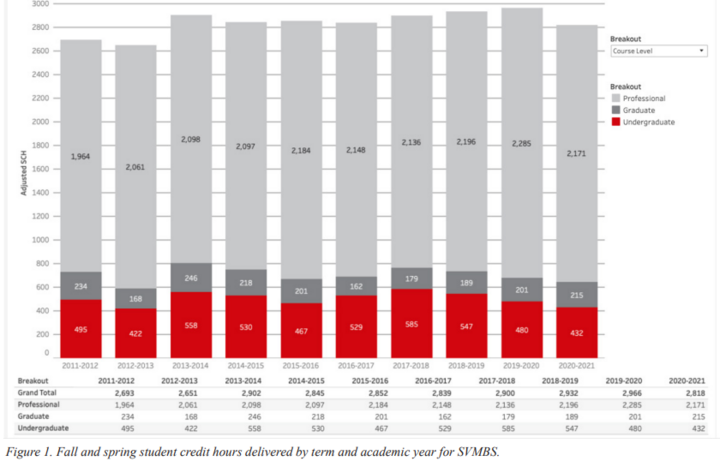
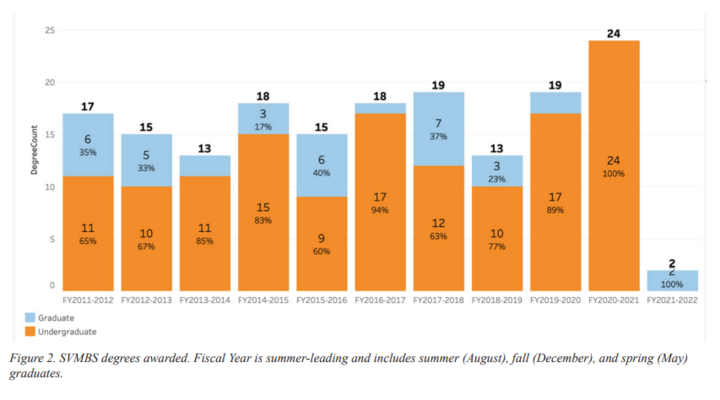
The importance of all educational programs is reflected in Figures 1 and 2, reflecting recent trends in hours taught and degrees awarded.
SVMBS educational goals support the UNL and IANR goals of increasing enrollment and offering affordable, accessible, and innovative education. SVMBS goals focus on providing students at all levels broader learning experiences.
Research
Research disciplines of faculty members include bacteriology, biochemistry, epidemiology, immunology, molecular biology, neurobiology, pathology, virology, and clinical veterinary medicine. Research projects are of both basic and applied nature and address disease pathogenesis, virulence mechanisms of pathogens, host responses, defense mechanisms, vaccine development, antibiotic mechanisms of action and resistance, diagnostic test development, and pathogen/host genomics in diverse hosts including livestock, poultry, and model species.
The UNL community has created a set of Grand Challenge objectives for responsible research (UNL | Grand Challenges). Three of these objectives are addressed by SVMBS research programs:
- Sustainable food and water security
- Health equity
- Climate resilience
SVMBS has strong programs in STEC food safety; molecular virology (cell biology, pathogenesis, immunology, and vaccinology); mycobacterial infections of ruminants, emerging and re-emerging viral diseases of swine (PRRS, ASFV); bovine respiratory disease and congestive heart failure; poultry pathology and medicine; as well as diagnostic pathology. These research programs are described within faculty biographic descriptions in Appendix 2 (available upon request).
Extension
SVMBS contributes to UNL extension through programs offered through Nebraska Extension. This includes programming at the Nebraska State Fair and multiple activities for secondary school students (Veterinary Extension at SVMBS). Even though most NVDC faculty do not have extension appointments, they provide significant outreach through consultations and diagnostic services offered to veterinarians and livestock producers. Continuing education/consultation for practicing veterinarians are offered through the Great Plains Veterinary Educational Center and are prominent parts of SVMBS outreach but are not considered formal extension programming. The NVDC and the associated poultry extension veterinarian (Dr. Don Reynolds) contributed significant diagnostic, epidemiological, and management advice to large and small poultry producers (as well as wildlife agencies) as part of the currently ongoing high-path avian influenza virus outbreak.
SVMBS extension faculty participate in formal extension activities such as the beef interest group, beef extension programming, interaction as specialists with educators and other extension specialists, as well as delivery of extension sponsored programming (e.g., feedlot roundtables, stocker/yearling field days, etc.). Also, these extension/outreach activities extend beyond Nebraska to national and likely international audiences. SVBMS faculty actively present research and continuing education programming at national veterinary and producer conferences.
Nebraska Veterinary Diagnostic Center
The Nebraska Veterinary Diagnostic Center provides veterinary diagnostic services to Nebraska’s livestock industry and serves as a resource for veterinarians. It offers necropsy, histopathology, virology, bacteriology, serology, molecular diagnostic, and limited clinical pathology services. Additionally, NVDC serves as a service center providing support and consultation on animal diseases for research faculty throughout the university and state. The NVDC is fully accredited by the American Association of Veterinary Laboratory Diagnosticians. The NVDC is a Level I member laboratory of the National Animal Health Laboratory Network (under USDA APHIS VS). NVDC is approved to conduct surveillance testing for numerous high consequence pathogens of livestock, horses, and poultry. The NVDC is a member of the FDA CVM’s VET-LIRN Network. The One Health mission is a critical component of NVDC’s mission, and the diagnosticians collaborate with the Nebraska Department of Health and Human Services (DHHS) for rabies, SARS-COV2, and zoonotic pathogen surveillance in animals in the state. A CLIA- licensed human testing laboratory was established in 2021 to support SARS-COV2 surveillance for the campus community to assure a safe environment. To date, over 300,000 tests have been performed.
Great Plains Veterinary Educational Center
The Great Plains Veterinary Educational Center is located near Clay Center, Nebraska, at USMARC. USMARC is a federal facility as part of the USDA ARS; GPVEC is a University of Nebraska facility within SVMBS. GPVEC was established in 1986 as part of a Cooperative Agreement for Veterinary Medical Education between UNL and Kansas State University. Over the years, GPVEC has developed as a nationally recognized center that provides training for veterinary students from across the U.S. GPVEC also provides consultation and support for practicing veterinarians and livestock specialists. A large part of the SVMBS veterinary extension effort is provided by GPVEC veterinary staff, and these faculty collectively support an active applied research effort in collaboration with USMARC (USDA ARS).
Budget and Program Support
The budget for SVMBS comes from multiple sources, primarily the State of Nebraska and USDA (via Hatch funds). Resources are allocated by the IANR deans and directors of the teaching (CASNR), research (ARD) and extension (Nebraska Extension) divisions. Research grants and service contracts are a major contributor to the School’s overall research budget. Extension budgets are primarily supported by state and USDA funds and, to a lesser extent, fee income and grants. The teaching program budget is primarily from state appropriations. The director of SVMBS is responsible for maintaining appropriate distribution of teaching, research, and extension funds as part of operational and discretionary support.
The NVDC budget is maintained separately from the teaching, research and extension budgets. NVDC receives appropriated funds for faculty salaries and a portion of the technical staff. Fees charged for laboratory services provided to extramural clientele helps pay additional salaries and operating expenses. Services provided to SVMBS and other units for teaching and research activities at UNL are provided at cost. Research grants and contracts contribute significantly to the NVDC budget. The NVDC director is responsible for managing the budget under the authority of the SVMBS director. Fee income from diagnostic services goes into a single revolving account which is administered by the NVDC director.
The director of GPVEC is responsible for managing the GPVEC budget in collaboration with the director of SVMBS. The budget is divided into teaching, research, and extension appointments. GPVEC is responsible for funding its own building maintenance, utilities, and custodial services, unlike units on the Lincoln campus, where facilities are supported centrally.
The SVMBS research support budget includes state appropriations and USDA Hatch funding. These funds are treated as a pool and are used to support individual faculty members and provide a central research support fund. Allocations to faculty members are under the control of the SVMBS director. Some research faculty members receive an annual allocation which they can use toward a research technician, a post-doc, a grad student, operating, travel or equipment. Individual research projects also may be funded as needed. General research support funds are used to support shareduse research equipment and facilities. Approximately 11% of the total facilities and administrative (F&A) fees charged to SVMBS grants are returned to the School. Eighty-five percent of the F&A dollars returned to the School are returned to the faculty member whose grant(s) generated the funds. This provides a substantial incentive and reward to faculty members who are successful in obtaining grants. Fifteen percent of the F&A cost return is administered by the SVMBS director to support the SVMBS seminar program and other central research needs.
Administrative support for SVMBS and PPVM currently consists of one administrative associate, one administrative support associate, and one communications specialist. Administrative support for GPVEC consists of one administrative support associate and one office associate. IANR provides business support to the School, PPVM, and GPVEC through the AVE Business Center. The AVE Business Center, which also manages business affairs for the Department of Animal Science, has a business manager, finance associate, finance coordinator, assistant business manager and finance/ grants specialist-Lead, finance/grants coordinator, and personnel coordinator. Administrative support for the NVDC consists of the business manager, an accounting assistant, an office supervisor, two transcription/medical records specialists, and a reception/medical records specialist.
Facilities
SVMBS has faculty members and facilities at multiple sites in Nebraska, including the Veterinary Science Complex buildings and the Nebraska Center for Virology (Morrison Center) on the UNL East Campus, and GPVEC at Clay Center, Nebraska (East Campus Map). There are additional facilities available to SVMBS on an as-needed basis that include the Animal Science Complex, the Life Sciences Annex, and laboratories within the NVDC facilities and the Morrison Center.
The Veterinary Science Complex consists of the Veterinary Medicine and Biomedical Sciences Hall and Annex, the Nebraska Veterinary Diagnostic Center, a Clinical Skills Laboratory, and the Biosafety Level 3 Core Facility (constructed in 2006). Building diagrams and maps are in Appendix 6A – D available upon request.
Veterinary Medicine and Biomedical Sciences Hall and Annex
The VBS Hall building (Appendix 5) has over 33,000 sq. ft. of useable space that houses research laboratories, several shared-equipment rooms, walk-in coolers, a glassware preparation area and offices for faculty, post-doctorates, graduate students, and staff. VBS also houses the administrative office for the School including staff offices, a conference room, study spaces, and storeroom. It has two large classrooms. The VBS building complex also includes an Annex with 15,000 sq ft for offices, study spaces, clinical teaching laboratories, and storage.
Nebraska Veterinary Diagnostic Center
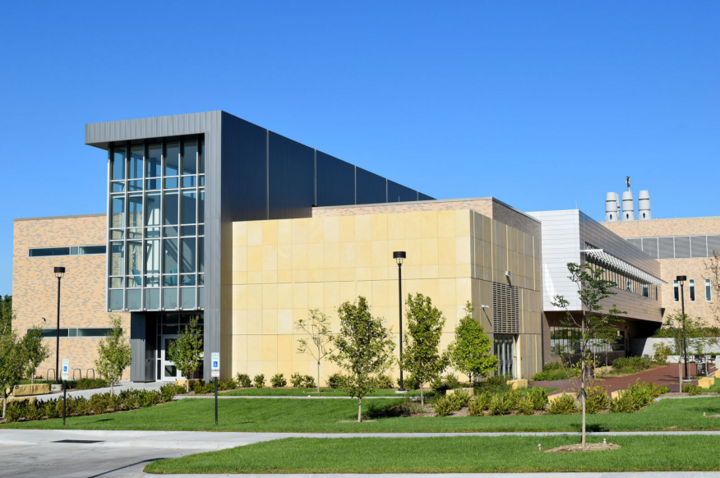
The physical space, including all laboratories, offices, corridors, lavatories, necropsy, and support space consists of 34,927 sq. ft. and was completed in 2017 (Figure 3). The laboratories consist of six different sections: sample receiving, necropsy, bacteriology, virology/serology, molecular diagnostics, and histology. The molecular section consists of a suite of three clean rooms with isolated access from a separate hallway. Thermocyclers are in their own amplification laboratory. There are three separate extraction rooms in their own respective hallway. In addition, there is an animal BSL-3 suite of approximately 2,125 sq. ft. and teaching space of 1,700 sq. ft. for clinical microbiology and an interaction space of approximately 2,430 sq. ft. Combined, there is a total of 40,582 net sq. ft. and 65,624 gross sq. ft.
Veterinary Clinical Skills Laboratory
The Veterinary Clinical Skills Laboratory was originally used to house/isolate large animal research subjects. It was renovated to provide teaching space for the Professional Program in Veterinary Medicine. It is a small building of approximately 2,300 sq. ft. The building provides storage areas for lab supplies, a restroom, and a garage area.
BSL-3 Facility
The Animal Bio-safety Level 3 (ABSL-3) laboratory in the NVDC allows work with biological hazards and small animals. This laboratory consists of a clean change space, dirty change space, tissue culture laboratory, air-lock waste handling room, decontamination room, common hallway, two holding rooms, and two procedure rooms.
There is an additional 1,500 sq. ft. BSL3 facility that includes an entry room, an anteroom, shower and changing room, a restroom, two inner laboratory rooms, and a separate mechanical room. Selected room doors require card access credentials. This facility supports in vitro laboratory work.
SVMBS is a long-standing program within IANR and CASNR. The core missions have been research, undergraduate and graduate teaching, the PPVM, extension, and operation of the state of Nebraska’s accredited veterinary diagnostic laboratory.
The GPVEC mission was developed in the 1990s and the PPVM was established in 2006.
SVMBS is managing through multiple transitions. Among them are a steady reduction in the number of faculty and support staff, evolving budget structures, evolving research foci and mechanisms of support, and the necessity to develop strategies to ensure diversity, equity, and inclusivity.
Over the course of the School’s history and into the present, there have been (and will continue to be) significant shifts in stakeholders, clientele, students, the collective sciences of veterinary medicine and animal health, as well as the relevant standards of practice. These changes require attention, with a renewed urgency, to both scientific and social needs. There are needs for veterinarians, veterinary technicians, animal health research scientists, as well as many allied professionals. Nearly 60% of all biomedical investments in research and development are focused on vaccines, diagnostics, and therapeutics. A large majority of this investment is focused on zoonotic infectious diseases. Maintaining educational programs to meet these demands will require attention to diversity of the students and professionals.
There is now significant academic attention on not only direct animal health, but also the general well-being of the animals and their caretakers. The diversity of the caretakers, in the broadest sense, will continue to increase. Clearly, all of these interactions are important and deserve full attention. And, sustained delivery of One Health medicine requires consideration of the global ecology.
SVMBS and IANR have demonstrated an ability to respond to critical evaluations and recommendations. From the 2015 APR, the NVDC added depth and expertise. Also, IANR, CASNR, and SVMBS have invested in maintaining operations and teaching/research programs at GPVEC. There have been successful research initiatives to address very specific needs related to stakeholders (livestock) and One Health (epidemiology of zoonotic diseases). Consistent with this approach, an SVMBS senior leadership team will lead the development of responses to these external review team and institutional leadership reviews and recommendations. This will be translated to strategic and tactical planning for SVMBS.
Key Topics
Several key topics and related questions have emerged throughout discussions and preparation of this self-study report:
The basis for growth and effectiveness of our educational programming is a diverse, talented, and motivated pool of students. These students will eventually become the people that enter critical sectors of the Nebraska economy such as food and animal agriculture and the regional One Health biomedical system as workers, educators, veterinarians, technicians, and research scientists.
Question 1a. How do we develop effective outreach and recruiting systems for Nebraska to identify a strong pool of students and ensure diversity, equity, and inclusivity? (Note: one of the objectives of the UNL community’s Grand Challenges is anti-racism and racial equity (UNL | Theme descriptions | Grand Challenges).
Question 1b. Are there strategic gaps in content and/or delivery in the educational programming for undergraduate students in the pre-veterinary or veterinary technology programs that enhance student success? Can the length of time required for the pre-veterinary program be reduced, reducing time and costs to acquire a D.V.M. degree? The rising financial burden on professional students is significant. Some specific examples of targeted recruitment programs could include urban high schools, community colleges, and students from rural regions of Nebraska.
Question 1c. What internal and external partnerships would enhance these efforts?
The PPVM and graduate degree programs are key components of the mission of SVMBS and there is demand for these graduates.
Question 2a. What is the appropriate structure and approach for the M.S. degree program(s) for SVMBS? One possible approach to continue an M.S. program would include using the CASNR-managed Master of Applied Science degree program to re-establish the program within SVMBS. As the School includes many missions and teams, the M.S. program needs to provide the flexibility to support students with diverse educational goals.
Question 2b. What possible novel and unique mechanisms of support for graduate students and veterinary residents can be developed (in addition to grant funding) to support and sustain growth?
Question 2c. For the PPVM program, what is the appropriate strategy to realize supported growth? There is currently sufficient demand and a number of well-qualified students to support expansion of the class size (by approximately 10 to 20 students). This will require additional and new professional program partners for the third and fourth year training opportunities.
Question 2d. What internal and external partnerships would enhance these efforts? (This could include development of unique clinical training programs, such as rotations/clerkships, etc., utilizing resources across Nebraska. And, such programs can be coupled with efforts to recruit veterinarians to underserved counties in Nebraska.)
Question 2e. Can such programs be used to leverage partnerships with other veterinary colleges to increase and enhance both the numbers of and diversity of PPVM-trained veterinarians for the unique veterinary service needs of this region?
There are multiple drivers of success for numbers 1 and 2 above. These questions address issues associated with these critical resources. A diverse, talented, and motivated faculty will be essential for the success of the SVMBS.
Question 3a. Assuming increased needs to recruit faculty after attrition and to support new programs, what is the best model for critical succession planning for both faculty and staff for SVMBS? How can we train, recruit, retain faculty and staff in a highly competitive environment for veterinarians that may have to realize significant opportunity cost? These efforts must realize critical needs among disciplines as well as needs for essential multiple accreditation and certification processes.
Question 3b. How best should inclusivity and a supported sense of belonging be purposefully included in this planning effort (and eventual recruitment actions)? This will be an important topic for the senior leadership team, and this may require establishment of a recruitment committee.
Question 3c. What other needs exist for facility and infrastructure improvements?
4. To achieve operational success and efficiency, program integration and coordination is a subject of interest to clients and stakeholders.
Question 4a. How might integration between units/areas within and outside the school be leveraged (such as resident training positions involved in teaching and GPVEC program integration with undergraduate programs as examples)?
Question 4b. Would there be advantages in better integration of research, diagnostic service, and extension programming in key areas (cow/calffeedlot management, related infectious diseases of livestock, and infectious disease/livestock ecology; as an example).
Question 4c. Relative to efficient uses of resources and succession planning, should SVMBS define two to three core areas of research strengths?