Content
Sampling Protocol
Sampled animals are to be selected based on clinical signs and, ideally, in the acute phase of infection.
If untreated animals are available, those animals should be selected first. Three to six representative animals should be selected for sampling.
- To begin, restrain the head of the animal in a headgate in processing chute or other immobilization device.
- Remove dirt and debris from exterior nares with a clean cloth.
- Estimate the distance from the nares to the medial canthus of the eye.
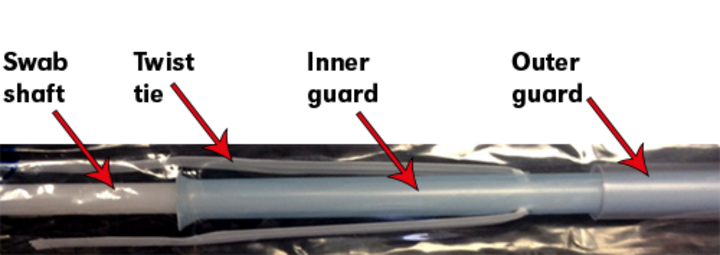
- Unwrap the end of the swab and the twist tie, and remove swabs from guard apparatus (this keeps the guards separate until ready for use).
- Insert the culture swab into the ventral meatus of the nose and advance it along the estimated distance from the nostril to the medial canthus of the eye. Put slight pressure downwards and toward the midline of the nose as you advance to ensure the swab stays in the ventral meatus and passes easily. Do not force the swab as this can cause excess bleeding and result in a poor sample.
- Retract the culture swab (not the guard) approximately 1-2 inches.
- Push the inner blue swab guard through the end of the outer guard.
- Push the swab through both guards and beyond the end of the inner guard for approximately 1-2 inches. Vigorously rotate the swab and advance and retract slightly (1/4-1/2 inches) against the pharyngeal mucosa for 30-45 seconds. You want to ensure an adequate number of cells and exudate are collected in the sample.
- Retract the swab into the inner guard and then retract the inner guard into the outer guard.
- Remove the entire double guarded swab from the nares.
- Remove the inner guard containing the swab from the outer guard.
- Remove the swab from the inner guard.
- Using a clean pair of scissors cut the cotton tipped swab roughly 4-7 inches from the tip.
- To avoid contaminating the swab, this must be done in a sterile fashion. Do not cut the swab too short as this can prove difficult to remove from the transport media.
- Open the Copan transport media tube (i.e. eSwab). Place the deep nasal swab that you collected into the Copan transport media tube and replace the cap. Make sure that the cotton-tipped swab is fully immersed in the liquid.
- Repeat the procedure with a different double guarded culture swab in the other nostril. Place the swab into viral transport media and swirl vigorously. Make sure the tube cap is closed tightly to avoid leakage.
- NOTE: Swabs placed in virus transport media cannot be used for bacterial culture.
- Label all transport media legibly with the animal’s identification number or name.
If the samples cannot be shipped immediately, they are to be temporarily stored at 4°C in a cooler or refrigerator.
Shipping Requirements
Fill out the Ruminant Submission form with contact information and requested testing.
- The Multiplex Bovine Respiratory PCR includes BVD, IBR, BSRV, and BCV.
- The BRD Bacti PCR includes H. somni, P. multocida, M. haemolytica, and Mycoplasma bovis screening and an aerobic culture.
NOTE: Sensitivity testing is not included in the cost of the panel price but will be conducted unless indicated otherwise.
- The Antimicrobial Resistance (AMR) PCR includes gene targets that confer resistance to macrolide drugs (msrE, mphE, erm42) or tetracyclines (tetR). The AMR PCR should be ordered in conjunction with the BRD Bacti PCR to ensure detection of both pathogens and resistance genes.
- The complete BRD panel offers all three PCR assays (Viral, Bacterial, AMR) in addition to aerobic culture at a reduced cost when comparing to individual tests.
- When submitting, send the samples overnight with a sufficient number of ice packs to ensure that they remain cold during shipment to the laboratory.Please contact the laboratory at 402-472-1434 if you have any questions.